March Forth!
March 4 is a big day in our household. We are not a winter-loving family, in general, so March, with its longer days and stronger sun, is most welcomed. (We’re not naive enough to think winter is over, by any means, but we can feel the energy of spring coming.) But March 4th - MARCH FORTH - is a great little sentence. If you spell it wrong (right?) it’ll tell you what to do. A piece of advice. A nugget of encouragement. It’s the day we embarked on a thru-hike of the Appalachian Trail in 2010, hiking up to Springer Mountain and determinedly marching forth toward New England, toward home. Every year we celebrate with at least a little nod, a little smile— spring is coming. We can do big things again.
So naturally, I chose to fire up our new heated greenhouse (propane for propagation!) on this day. Marching forth into yet another chapter of our little diversified farm.
The day the propane got plumbed and tanks installed, I greeted my second-grader excitedly with the news as he got off the school bus. Reuben watched me flip the switch and I could see he was thinking about something as he listened to the heater come on and followed the propane line out to the tanks with his eyes. “Mom, does this new greenhouse make climate change worse?” he asked. Whoa. I was a little thrown off, but it lead to a great conversation about choices and values. There is no black and white, every single decision we make has effects and consequences. He argued that if we didn’t heat the house with propane, we’d use fewer resources and have less of an impact on the earth. I explained that heating the house with fuel is a choice we made, and yes, it does require more resources, but growing healthy seedlings for our farm and for sale to our community will allow more people to eat good nutritious food from right here, rather than shipping it long distances. The way we produce food is in line with our values— we have a robust ecosystem surrounding and included in the food production aspect of our farm. We focus on building soil health, integrating biodiversity, and minimizing harm to the environment. We talked about cover cropping and planting trees, about being certified organic and choosing not to spray our food with chemicals. We talked about all the local households we get the opportunity to grow food for, and interact with, and how important to us it is to know and show care for our community.
I wasn’t really thinking that showing Reuben the new heater would lead to a big parenting moment and an in-depth discussion of food production, messed-up agricultural systems in the world, and what I believe in as a farmer, but I should have known. He’s smart as a whip, and always paying attention.
All this to say: we have a new heated propagation house this year! And it’s filling up quickly with healthy certified organic seedlings. Very exciting stuff here at Boneyard Farm. Also: if you want to know something about the way your food is grown, ask questions. Get to know your farmer. (Find yourself someone you can call “your farmer.”) Dig in. Lead with respect and curiosity and kindness, of course, but don’t shy away from difficult questions or conversations. I feel sure that nobody has stronger opinions about food production and land stewardship than those of us out here doing it every day.
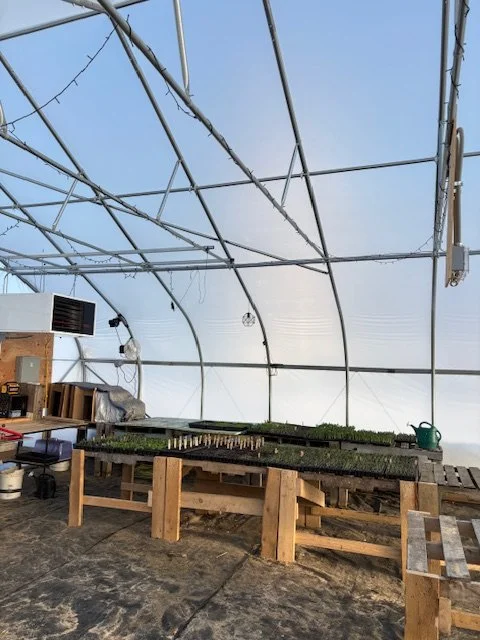
New heated greenhouse, March 2026.